

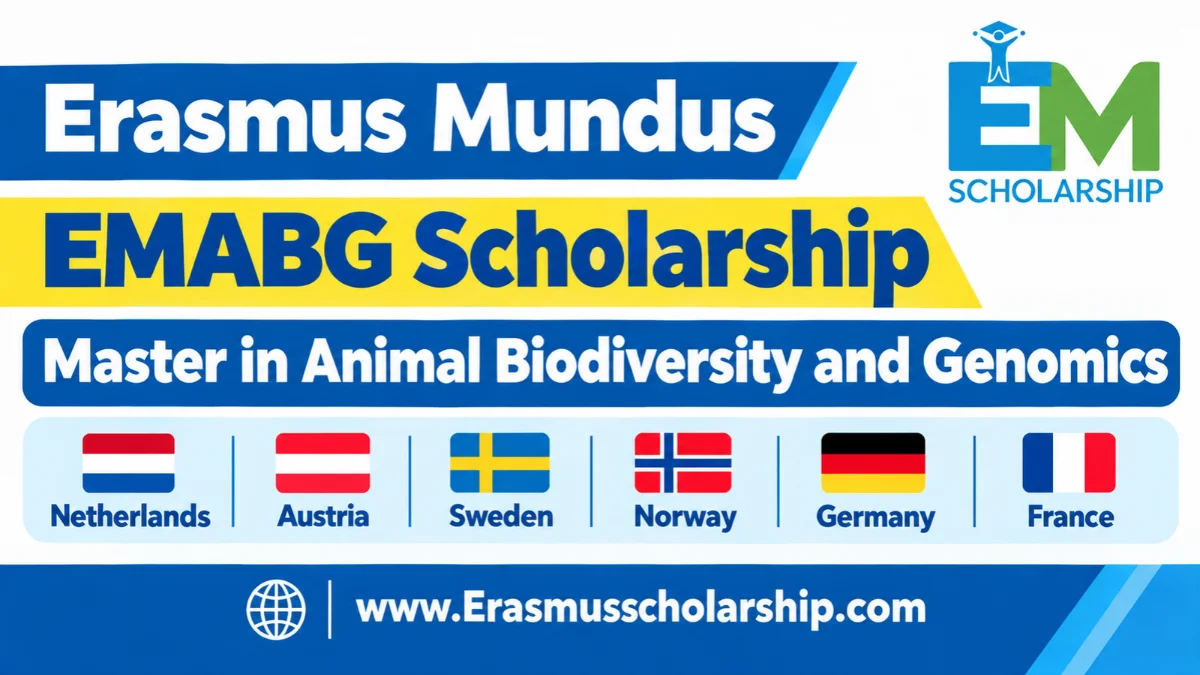
Two years, Two universities, Six countries to choose from. The (EMABG) Erasmus Mundus Joint Master in Animal Biodiversity and Genomics moves students through Europe rather than keeping them in one place. Year 1 is spent at one consortium university. Year 2 at a second university chosen for specialization. Both years are fully funded through Erasmus+.
The program runs entirely in English, spans institutions in the Netherlands, Austria, Sweden, Norway, Germany and France, and awards a joint Master’s degree at the end. For students interested in animal genetics, conservation science or sustainable livestock systems, it is one of the most comprehensive graduate programs of its kind in Europe.
Applications Erasmus EMABG Scholarship 2027 are open on September 2026. The deadline falls in January.
Key Details About Erasmus Mundus EMABG Scholarship
| Detail | Information |
| Program | Erasmus Mundus Joint Master in Animal Biodiversity and Genomics (EMABG) |
| Duration | 2 years, 120 ECTS |
| Degree | Joint Master’s Degree |
| Language | English |
| Partner universities | 6 universities across Europe |
| Funding | Fully Funded |
| Applications open | 15 September 2026 |
| Application deadline | 15 January 2027 |
| Program start | Early September |
Six Universities One Degree
The EMABG is delivered jointly by:
- Wageningen University & Research — Netherlands
- University of Natural Resources and Life Sciences BOKU — Austria
- Swedish University of Agricultural Sciences SLU — Sweden
- Norwegian University of Life Sciences NMBU — Norway
- University of Göttingen — Germany
- AgroParisTech APT — France
Wageningen consistently ranks among the top agricultural universities in the world. The other five institutions are leading research universities in their respective countries, each with strong programs in animal science, genetics and related fields.
Students do not choose just one of these institutions. They study at two of them — spending Year 1 at one consortium university for foundational coursework then moving to a second university in Year 2 for advanced specialization and thesis research.
What You Actually Study
The program sits at the intersection of three disciplines that are increasingly inseparable in modern agriculture and conservation: animal biodiversity, breeding science and genomics.
Year 1 covers core interdisciplinary coursework in genetics, genomics and biodiversity, along with foundational and welcome modules designed to bring students from different academic backgrounds onto common ground.
Year 2 shifts toward advanced courses tailored to a chosen study track culminating in an independent research thesis. The full program totals 120 ECTS credits.
Students are also encouraged, though not formally required, to pursue additional research placements, collaborative projects and external internships. These opportunities arise through the program’s connections with research institutes and industry partners across Europe.
The Funding Package
Erasmus+ scholarship holders receive:
- Full tuition and participation fee coverage
- Monthly living stipend for the two-year duration
- Travel allowance and visa cost contribution
- Health and liability insurance coverage
- Support for academic mobility between consortium universities
A limited number of consortium scholarships may also be available. Financial conditions should be verified on the official program portal for the specific intake year.
EMABG Eligibility Requirements
The program is open to international applicants worldwide. To be eligible, you need:
- A Bachelor of Science degree minimum 180 ECTS in animal science or a closely related field
- Demonstrable knowledge in agricultural sciences, genetics, statistics and animal production if your degree is from a different discipline
- English proficiency through IELTS Academic, TOEFL iBT or an equivalent recognized test
Current English requirements include IELTS Academic at least 7 with speaking minimum 6.5 or TOEFL iBT at least 92 with speaking minimum 23. Certificates must be no older than two years before the deadline.
The program does not require publications or prior research experience as a formal condition. In practice applicants with laboratory work fieldwork or thesis research in genetics biodiversity or animal science tend to present stronger applications.
Application Documents
Prepare these before the September window opens:
- Bachelor’s degree certificate and official transcripts
- English proficiency test results
- Curriculum Vitae
- Motivation letter
- Two academic or professional recommendation letters
- Passport or national identification copy
- 1- to 2-minute video explaining why you want to join the program
Documents must be submitted in PDF format via the official EMABG application database. Incomplete applications are not considered.
Application Timeline
| Stage | Period |
| Applications open | 15 September 2026 |
| Application deadline | 15 January 2027 |
| Selection and review | February to March |
| Results notification | March to April |
| Program start | Early September |
How to Apply
- Visit the official EMABG application portal
- Register and create an account
- Complete personal, academic and background sections
- Upload all documents in PDF format
- Provide referee contact details for recommendation letter uploads
- Upload the required motivation video
- Review carefully and submit before the 15 January 2027 deadline
- Shortlisted candidates may be invited for a selection evaluation
One procedural note: application timelines shift slightly between intake years. Always confirm exact dates directly on the official portal rather than relying on third-party posts.
Where Graduates Go
Alumni of the EMABG program move into a range of fields after graduating.
Common career paths include research positions at universities and institutes, roles in conservation organizations and biodiversity projects, sustainable agriculture and livestock production and genomic data science. A significant portion of graduates pursue PhD studies in genetics or related fields.
The combination of international exposure, interdisciplinary training and a degree jointly awarded by multiple European institutions gives graduates unusual credibility across both academic and applied sectors.
Making Your Application Competitive
A few things that consistently strengthen EMABG applications:
Motivation letter specificity. Generic enthusiasm for animal science will not distinguish you. Reviewers look for applicants who can articulate why animal biodiversity and genomics specifically, why this consortium and what they intend to do with the degree. The more concrete and honest that answer, the stronger the letter.
Recommendation letters aligned with the program’s focus. Letters that speak directly to your quantitative skills, research aptitude or experience in genetics or animal science carry more weight than general character references.
Academic background alignment. Applicants from animal science, genetics, biology, agricultural science or statistics are directly eligible. Applicants from adjacent fields need to demonstrate relevant coursework or research experience in the prerequisite areas like genetics, statistics, animal production and agricultural sciences.
The short video is mandatory. Use it to convey genuine interest and clarity rather than polished production values.
