

What happens to the human body after months in orbit? Muscles weaken, the heart adapts, sleep falls apart. The same questions matter on polar expeditions and in other extreme places on Earth.
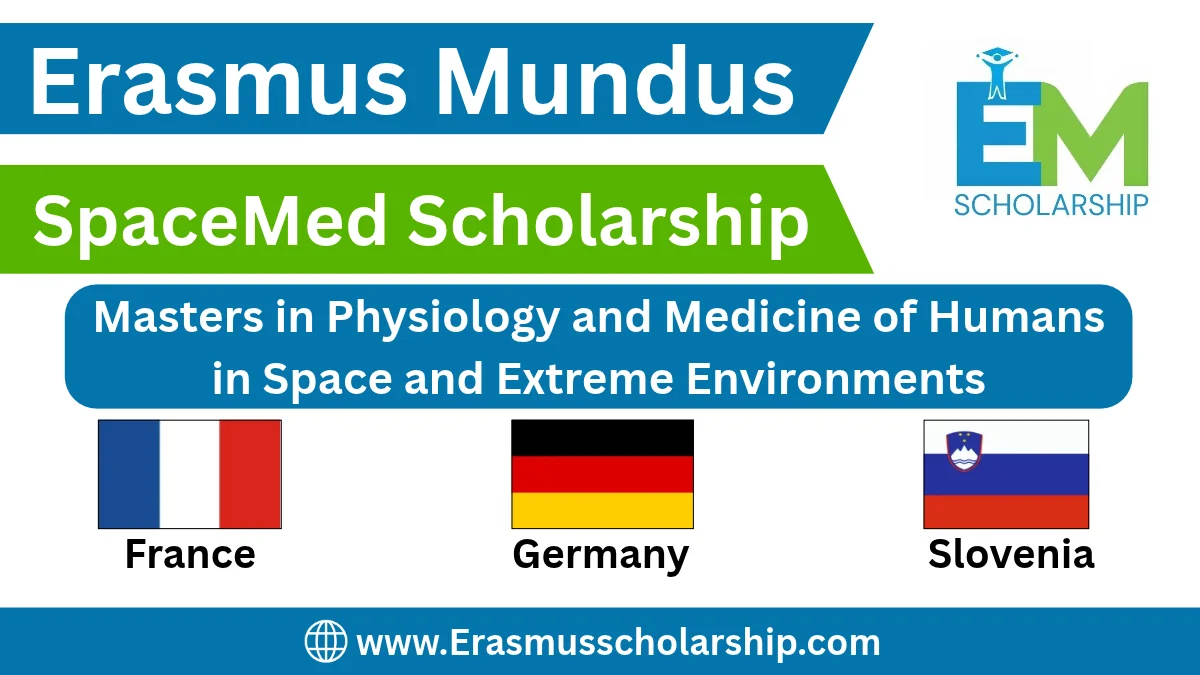
The SpaceMed Erasmus Mundus Joint Master Degree is built around those questions. It is a two-year, English-taught program in Physiology and Medicine of Humans in Space and Extreme Environments, with study in France, Germany and Slovenia. Erasmus+ funding is available.
Applications for the Erasmus Mundus SpacMed scholarship are open in October and closes in January. That makes this the right week to start preparing.
Details About Erasmus Mundus SpaceMed Scholarship
| Detail | Information |
| Program | SpaceMed Erasmus Mundus Joint Master Degree |
| Field | Physiology and medicine of humans in space and extreme environments |
| Duration | 2 academic years (120 ECTS) |
| Language | English |
| Countries | France, Germany, Slovenia |
| Funding | Erasmus+ Joint Master funding |
| Usual timeline | October 2026 |
| Deadline | January 2027 |
| Exact deadline | Confirm on the official website |
Where You Will Study
The program moves with you. Each semester has a different home.
| Stage | Location | Focus |
| Year 1, Semester 1 | Université de Caen Normandie, France | Core human physiology and extreme environments |
| Year 1, Semester 2 | Charité Universitätsmedizin Berlin, Germany | Advanced physiology and space medicine research |
| Year 2, Semester 3 | Jožef Stefan International Postgraduate School, Slovenia | Specialization and research preparation |
| Year 2, Semester 4 | Any partner or associated institution | Master’s thesis, with an optional internship |
The Slovenian partner appears in the source under its Slovenian name, Mednarodna podiplomska šola Jožefa Stefana. It is the same institution.
The final semester is the most flexible one. You choose where to do your thesis or internship from the partner and associated institutions.
What the Scholarship Offers
Erasmus+ Joint Master funding is the main support. The source lists these benefits:
- Tuition coverage
- A monthly living allowance
- Travel and installation support
The source does not state the allowance amount. Confirm current figures on the official site before you budget.
Self-funded and employer-sponsored students can also apply. The source says competition is intense, and scholarships go to a limited number of top-ranked candidates each year.
Also Read: Erasmus Mundus MIPDaL Scholarship 2027 | Master in Intellectual Property and Data Law
Admission Requirements
You must have one of the following qualifications:
- A Bachelor’s degree in Life Sciences, Psychology, or Kinesiology worth 180 ECTS credits or equivalent.
- A Master’s degree in Engineering.
- A medical degree.
- A degree that includes major academic study of humans in space or extreme environments.
English Language Requirements
- You must have English proficiency at B2 level or higher under the Common European Framework of Reference for Languages (CEFR).
- You can meet this requirement in one of the following ways:
Option 1: English Language Test
Submit one of these certificates issued within the last three years:
- IELTS: Minimum overall score of 6.5.
- TOEFL: Minimum 580 (paper-based), 237 (computer-based), or 87 (internet-based).
- Cambridge English: B2 First certificate.
Note: The Online Linguistic Support (OLS) test is not accepted.
Option 2: Native English Speakers
- If English is your native language, you do not need to take an English test.
- You must submit a signed declaration on honour confirming that you qualify for this exemption.
Option 3: Previous Education in English
- If you completed your previous studies in English, you can submit an official certificate from your university confirming that English was the language of instruction.
Documents to prepare
- Bachelor’s degree certificate and transcripts
- Proof of English language proficiency
- Curriculum vitae
- Motivation letter
- Passport identification page
What Makes a Motivation Letter Stand Out
SpaceMed is a narrow field, so reviewers will notice generic letters. Based on the program’s own guidance, three things help:
- A clear reason for choosing space medicine and human physiology, not just “medicine abroad”
- Relevant coursework, lab time or research experience, named specifically
- Interest in studying across countries and disciplines, backed by an example if you have one
The source lists thesis topics that show the range: cardiovascular and musculoskeletal deconditioning, sleep research, cognitive performance, and space suit ergonomics. Pick one that fits you and say why.
How to Apply for Erasmus Mundus SpaceMed Scholarship
The process is short:
- Open the official SpaceMed website and find the application portal
- Complete the online form
- Upload every required document
- Review the whole application
- Submit before the deadline
Start the motivation letter first, because it takes the longest.
