
Applications for the Erasmus Mundus GLOBE Scholarship are open now for 2027 academic year. It is a two-year joint master’s program for students who want to become experts in solving global environmental problems and protecting biodiversity. You learn how climate change, land use, and human activities affect ecosystems and how to create practical solutions for conservation and sustainable development. The program mixes ecology, data science, policy and fieldwork in Europe and Mexico. You study in Spain, United Kingdom and Portugal with summer school in Mexico at four top universities. The Erasmus Mundus GLOBE program starts in September 2027 and offers full scholarships to the best students from any country. You may also like Erasmus Mundus MorphoPHEN Scholarship.
Details About the Erasmus Mundus GLOBE Scholarship
| Feature | Details |
|---|---|
| Program Name | GLOBE – Global Change to Biodiversity Solutions |
| Duration | 2 years full-time (120 ECTS) |
| Degree Type | Joint master’s degree from multiple universities |
| Host Countries | Spain, United Kingdom, Portugal, Mexico (summer school) |
| Funded By | Erasmus+ Programme – European Union |
| Total Scholarships | Around 15–20 full scholarships each year (up to 80 across intakes) |
| Monthly Money | €1,400 for 24 months |
| Start Date | September 2027 |
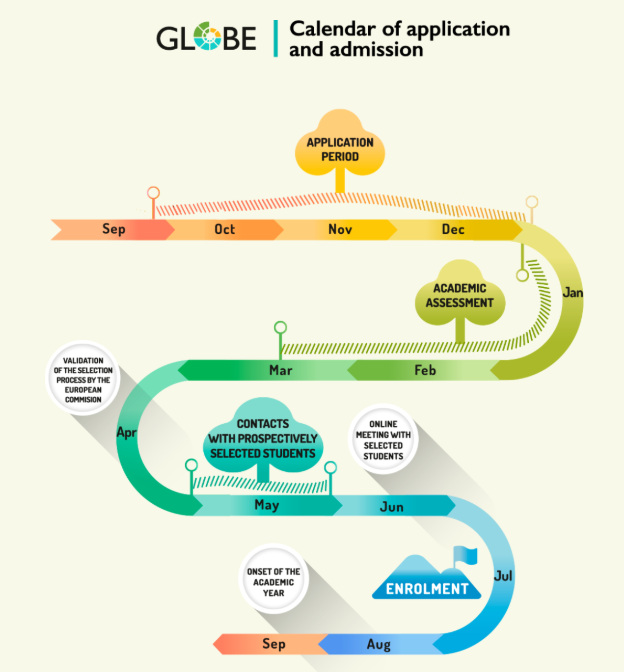
| Application Opens | September 28, 2026 |
| Scholarship Deadline | January 4, 2027 |
| Self-funded Deadline | Later (check website) |
| Contact | project.globe@urjc.es |
Host Universities
- Universidad Rey Juan Carlos – URJC (Spain) – first semester, strong in global change ecology, data analysis, and Madrid-based research excellence
- Bangor University (United Kingdom) – second semester, expert in biodiversity conservation with applied social and ecological sciences in Wales
- Universidade de Lisboa (Portugal) – third semester, leader in environmental management, governance, and bioeconomy with Lisbon’s Atlantic focus
- Universidad Autónoma de Tlaxcala – UATx (Mexico) – summer school, focus on community engagement and ecosystem studies in Mexican biodiversity hotspots
What Students Learn From GLOBE Erasmus
- Global change ecology and how climate and humans impact ecosystems.
- Data analysis and scientific methods to study environmental changes.
- Biodiversity conservation strategies and how to protect species.
- Environmental management and sustainable resource use.
- Governance and policies for nature protection and green economy.
- Bioeconomy principles and how to use nature sustainably.
- Fieldwork skills in diverse ecosystems from Europe to Mexico.
- Interdisciplinary approaches combining science, society and policy.
Also See: Erasmus Mundus GLOFOR Scholarship | Master in Global Forestry
Why Choose the GLOBE Program
- Strong focus on global change and biodiversity solutions.
- Study in three European countries plus Mexico summer school.
- Full scholarship covers tuition, living, travel, and fieldwork.
- Hands-on fieldwork and community projects in real ecosystems.
- Small international class for personal support and global friendships.
- Joint degree from top universities valued worldwide.
- Preparation for urgent environmental challenges like climate and loss of nature.
- Strong network with European and Mexican research institutions.
Study Path and Mobility
- Semester 1 – Universidad Rey Juan Carlos, Spain Introduction to global change ecology, data analysis, scientific writing, field course.
- Summer – Universidad Autónoma de Tlaxcala, Mexico 3-week intensive summer school with ecological immersion (5 ECTS).
- Semester 2 – Bangor University, United Kingdom Biodiversity conservation through social and applied sciences.
- Semester 3 – Universidade de Lisboa, Portugal Environmental management, governance, bioeconomy, field projects.
- Semester 4 – Any partner or associated institution Masters thesis (25 ECTS) with independent research.
Also See: Erasmus Mundus EMMaH Scholarship
Admission Requirements
- Bachelor degree (180 ECTS) in biology, environmental sciences, geography, or related.
- Strong academic record.
- English proficiency – CEFR B2 (IELTS 5.5, TOEFL 72, Cambridge B2 160).
- Motivation for ecological and social environmental challenges.
Scholarship Benefits
- 100% tuition fee
- €1,400 every month for 24 months
- Health insurance
- Installation allowance €1,000
- Travel money €2,000 to €3,000 per year
How to Apply for Erasmus Globe Scholarship
The application has 2 stages. You must complete Stage 1 first. Only shortlisted applicants can move to Stage 2.
Stage 1: Online Application
Application period: September 28, 2026 – January 4, 2027
- Complete the online application form through the “Apply Now” section.
- There is no need any supporting document at this stage.
Personal Information
You will need to provide:
- Your original name exactly as shown on your passport
- Your original Family name exactly as shown on your passport
- Current city and country
- Passport number
- Nationality
- Email address
- Use the same email throughout the application.
- Use a personal email instead of a university email because you may lose access to your university account during the selection process.
Academic Background
Provide details about your Bachelor’s degree:
- Year of graduation
- Official BSc degree title
- Main subject or specialization
- BSc GPA exactly as shown on your transcript
- University name
- Lowest passing grade
- Details of any completed Master’s degree
- Highest possible grade in your grading system
English Language Requirement
- You must have at least B2 level English by January 4, 2027.
- There is no need to provide an English certificate if you are:
- A citizen of a majority English-speaking country, or
- A graduate of a university in a majority English-speaking country under the UKVI definition.
- Other applicants must provide details of an accepted English qualification.
- Accepted tests include IELTS, TOEFL, and Cambridge English qualifications.
Motivation and References
You must also provide:
- A link to a 1–2 minute introduction video explaining who you are and why you want to join GLOBE.
- Contact details of 2 referees, such as professors, supervisors, employers, or other suitable academic/professional contacts.
- Referees will only be contacted if you reach the next stage.
Stage 2: Supporting Documents
Expected period: January–February 2027
- Only shortlisted applicants will be invited to Stage 2.
- You will need to provide official documents to verify the information given in Stage 1.
1. Passport
- Submit a valid passport as proof of nationality.
- Your passport should remain valid for the full 2-year programme.
- If you have more than one nationality, select the nationality you want to use for your application.
2. Degree Certificates
- Submit authenticated copies of all completed higher-education degrees.
- Certificates must be officially authenticated or have an Apostille.
- Include certificates for your BSc, MSc, PhD, or any other completed higher degree.
- If your certificates are not in English, provide an English translation from a sworn translator.
3. Academic Transcripts
- Submit complete transcripts in English.
- Include your BSc transcript and MSc transcript if applicable.
- Transcripts should show:
- Completed courses
- Grades
- Credits earned
4. English Certificate
If you provided an English qualification in Stage 1, submit the official certificate in Stage 2.
Minimum scores:
- IELTS: 5.5 overall
- TOEFL iBT: 72
- Cambridge English: B2 level with a minimum score of 160
If you qualify for an English exemption, you do not need to submit a test certificate. Instead, provide a declaration explaining whether your exemption is based on nationality or education, along with supporting documents when required.
5. CV
- Submit your Curriculum Vitae.
- Include your education, work experience, and relevant research experience or achievements.
- The CV must be prepared in Europass format.
6. Declaration of Veracity
- Complete the required Declaration of Veracity.
- The template will be available on the Stage 2 application platform.
7. Postgraduate Eligibility Certificate
- Applicants whose home university is outside the European Higher Education Area (EHEA) must provide a certificate confirming that their Bachelor’s degree allows them to enter a recognized postgraduate programme in the country where the BSc was awarded.
- The certificate must be issued by your home university using the required template.
- Applicants from universities within the EHEA do not need this certificate.
- Instead, they must submit a declaration confirming that their university is part of the EHEA.
Career Opportunities
- Biodiversity conservation specialist
- Environmental policy advisor
- Work in UNESCO, IUCN, or EU nature bodies
- Researcher in global change labs
- NGO expert on ecosystem protection
- Consultant for sustainable land use
- PhD in ecology or environmental science
FAQs
Q1. What is GLOBE?
A. Master program on global change to biodiversity solutions in Europe and Mexico.
Q2. Who can apply?
A. Biology, environmental sciences students with good English.
Q3. Is summer school in Mexico?
A. Yes – 3 weeks in Tlaxcala.
